
Building Systems
PEX vs Copper for Residential Renovation Plumbing in MA
PEX vs copper for renovation plumbing, when each makes sense, MA code considerations. Real cost differences, and what a 20-year-out home will look like.
3 min read · Published March 20, 2026 · Updated April 28, 2026
A licensed contractor compares PEX vs copper for residential renovation plumbing in Massachusetts, cost, durability, code, and which to specify when.
The short version
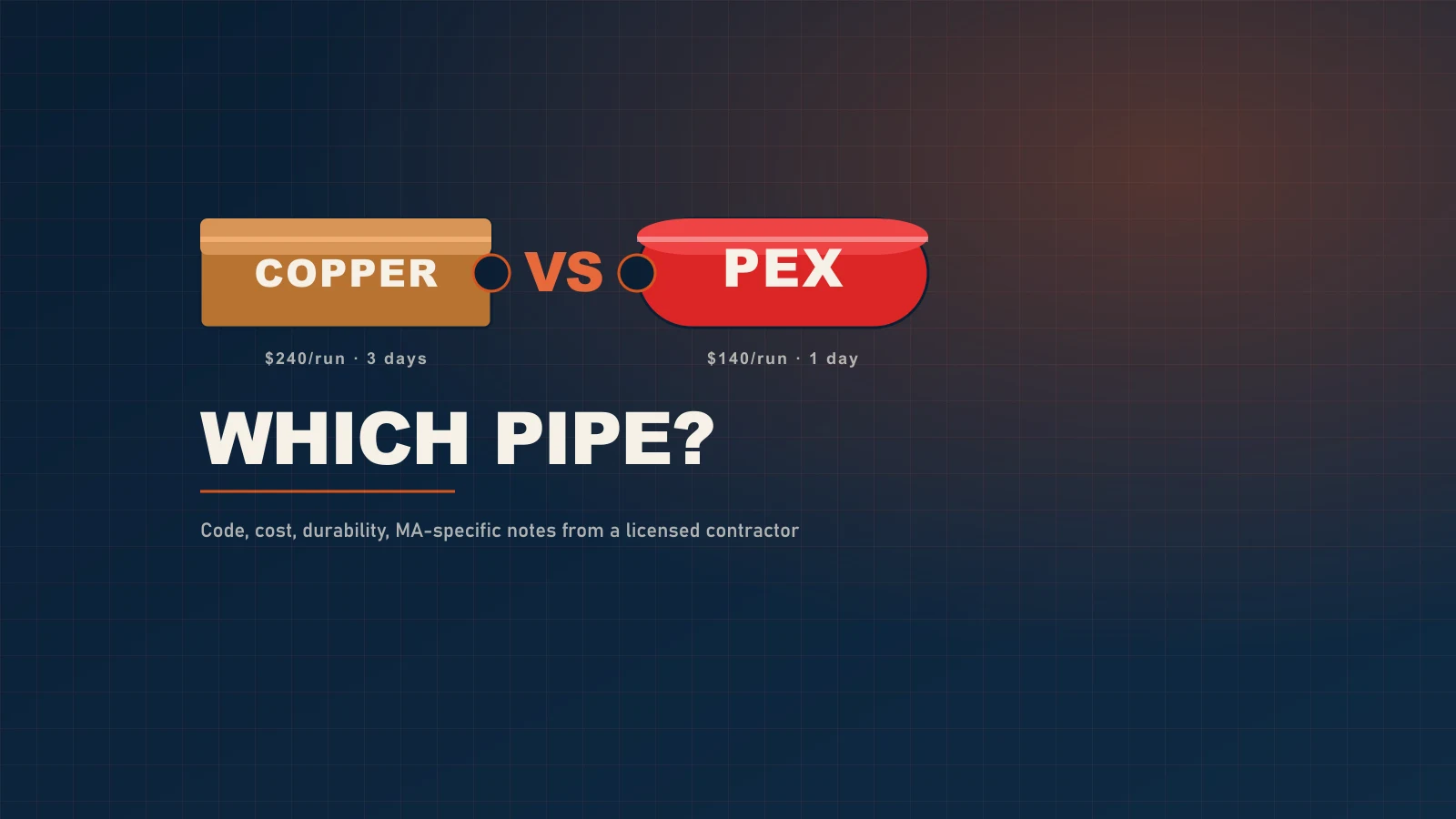
For most renovation supply lines in Massachusetts, PEX-A is the right call. It's faster to install, frost-tolerant, accepted under MA plumbing code, and costs roughly 30–40% less than copper for the same run. Copper still wins for exposed mechanical room runs you want to look industrial, for high-temperature applications, and for stub-outs to fixtures where the visible end matters.
We use both. Here's how we pick.
Why PEX wins most of the time
Speed. A PEX manifold install for a typical bathroom takes a day. The same run in copper is 2–3 days of solder joints. On renovation timelines that's a real difference.
Frost tolerance. PEX expands without splitting if a line freezes. Critical in Massachusetts older homes with exterior-wall supply lines.
Fewer joints, fewer leaks. A PEX manifold eliminates almost all in-wall joints. Each fixture gets a continuous run from the manifold. Joints (where leaks usually happen) live in the mechanical room where they're accessible.
Cost. Materials run roughly 40% less than copper. Labor runs 40–50% less because no soldering.
Where copper still beats PEX
Exposed runs. Copper looks like copper. PEX looks like a vinyl tube. For a finished basement bar where the lines are visible, copper is the call.
High-temperature loops. Some boiler heat-exchanger applications run hotter than PEX-A's spec. Copper handles it.
Existing copper systems. If 80% of the supply system is copper and you're only renovating one bathroom, mixing systems gets complicated. We sometimes match copper for the integration.
UV exposure. PEX degrades under direct UV. Anywhere the line might see sunlight (an exterior wall behind glass block, for example), copper.
MA plumbing code considerations
Massachusetts adopted PEX in residential plumbing in 2007. As of 2026, PEX-A and PEX-B are both code-compliant for cold and hot water supply (typically up to 200°F at 80 psi). A few specifics:
- Pressure-rated fittings only. Push-to-connect fittings (SharkBite-style) are code-allowed if they're listed for in-wall use, but most inspectors prefer crimp or expansion fittings. We use Uponor expansion (PEX-A) almost exclusively.
- Distance from heat sources. PEX must be sleeved or kept 6"+ from gas water heater flue.
- Manifold systems. Strongly preferred, gives you a single shutoff per fixture and far fewer in-wall joints.
Real cost comparison (60-foot supply run, 1/2" line)
| System | Materials | Labor | Total | |---|---|---|---| | Copper L | $180–$240 | $560–$720 | $740–$960 | | PEX-A (Uponor) | $90–$140 | $280–$400 | $370–$540 |
Numbers reflect 2026 Southeast MA pricing for a contractor-managed rough-in (not DIY).
What we'd specify on a typical project
Whole-house repipe: PEX-A manifold to every fixture. Copper from main shutoff to manifold (8–12 ft). Mechanical room looks clean, in-wall connections are minimal, every fixture has its own shutoff.
Single-bathroom remodel: Match the existing system if it's only one room. Don't introduce a manifold for a single fixture set.
Kitchen remodel with island: PEX-A run under the slab in conduit (sleeved). Copper stub-up at the sink and island.
Basement bar / wet bar: Visible run. Copper. The bar is a feature, not a closet.
What we'd never do
- Use push-to-connect (SharkBite) fittings in a wall that gets closed. They're convenient but they're not designed for permanent in-wall use, even when listed for it.
- Mix PEX brands and fittings. Uponor PEX uses ProPEX expansion fittings; Wirsbo uses Wirsbo. Crossing brands voids warranties.
- Run PEX through metal stud framing without grommets. Vibration over time will wear through the tube.
- Solder a copper joint near combustibles without the proper shielding. Most fires from plumbing renovation start here.
What we'd quote you
Bathroom rough-in (supply + drain) for a typical hall bath runs $2,800–$4,200. Kitchen rough-in runs $1,800–$2,800. Whole-house repipe (3 bath, kitchen, washer hookup) runs $8,500–$14,000.
Tell us about the project and Glenn will walk it within a week.
- plumbing
- PEX
- copper
- Massachusetts code
- renovation